Let’s learn Japanese with Reiner’s quote from Attack on Titan (進撃の巨人, Shingeki no Kyojin).
CONTENTS
Video
Reiner’s Quote
Japanese: 俺のすべきことは、自分のした行いや選択に対し、戦士として最後まで責任を果たすことだ。
Romaji: ore no subeki koto wa, jibun no shita okonai ya sentaku ni taishi, senshi toshite saigo made sekinin o hatasu koto da.
English: The only choice for me now is to face the consequences of my actions and as a warrior fulfil my duty to the bitter end.
Analysis
The sentence is a bit long, so I’ll divide it into two parts: the main clause, which stands as a complete sentence, and the subsidiary part, which provides additional information.
Main Clause: 俺のすべきことは戦士として最後まで責任を果たすことだ.
This follows the basic structure “Noun Aは Noun Bだ“, meaning “Noun A is Noun B”. We’ll break down each noun.
Noun A: 俺のすべきこと
The structure involves an adjective clause 俺のすべき modifying the following noun こと.
俺 (pronoun) means “I” in an informal and masculine way.
の (particle) indicates the subject in an adjective clause, functioning similarly to が.
The subject marker の in an adjective clause can be replaced with が. In the comic, が is used:
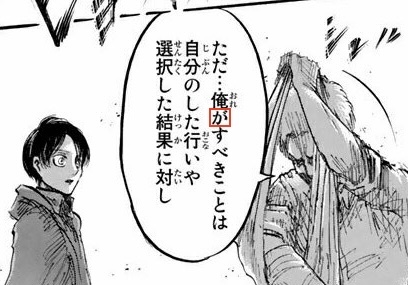
すべき means “should do”. It’s formed by combining す, which is the classical form of する meaning “to do”, and べき meaning “should”.
こと means “things” that are abstract or intangible.
So, 俺のすべきこと means “things that I should do”.
Noun B: 戦士として最後まで責任を果たすこと
戦士 (noun) means “warrior”.
として (particle) means “as”.
最後 (noun) means “end” or “last”.
まで (particle) means “until”.
責任 (noun) means “responsibility”.
を (particle) marks the direct object of an action.
果たす (verb) means “to fulfil”.
こと, in this case, is used as a nominaliser which doesn’t have a specific meaning on its own, but it turns a verb into a noun to indicate the action as a concept.
So 戦士として最後まで責任を果たすこと means “to fulfil my responsibility as a warrior until the end”.
So the main clause 俺のすべきことは戦士として最後まで責任を果たすことだ means “What I should do is to fulfil my responsibility as a warrior until the end”.
Subsidiary Part: 自分のした行いや選択に対し
This also contains an adjective clause, which modifies the following noun. Let’s break it down.
自分 (pronoun) is used to refer to the same person within the same sentence. In this case, it refers to 俺 which was mentioned earlier. In Japanese, instead of repeating, we often use 自分 to avoid redundancy.
の (particle), again, indicates the subject in an adjective clause, functioning similarly to が.
した (verb) means “did”. It’s the past tense of する (to do).
行い (noun) means “action”.
選択 (noun) means “choice”.
や (particle) is used to list representative things. It’s similar to “and”, but it also implies that there are other similar things not mentioned in the list. In this case, it could include things like his decisions, words, and so on.
So 自分のした行いや選択 means “the actions I took and the choices I made.” In Japanese, we use the verb する with these nouns, such as 行いをする (to take actions) and 選択をする (to make choices), so 自分のした can modify both 行い and 選択 with a single verb.
に対し indicates the target of an action, emotion, or attitude. In this case, it refers to what his responsibility is directed towards.
So, 自分のした行いや選択に対し means “for the actions I took and the choices I made” or simply, “for my actions and choices”.
So today’s quote 俺のすべきことは自分のした行いや選択に対し戦士として最後まで責任を果たすことだ means “What I should do is to fulfil my responsibility as a warrior until the end for my actions and choices”. In the anime, it translates to “The only choice for me now is to face the consequences of my actions and, as a warrior, fulfil my duty to the bitter end”.
Examples
Verb Dictionary-Form + べき (should)
借りたお金は返すべきだ。
karita okane wa kaesu beki da.
You should pay back borrowed money.
約束の時間の5分前には着くべきだ。
yakusoku no jikan no go-fun mae ni wa tsuku beki da.
You should arrive 5 minutes before the appointed time.
お金を拾ったら警察に届けるべきだ。
okane o hirottara keisatsu ni todokeru beki da.
If you find money, you should turn it in to the police.
Difference Between べき and なければならない
1. べき is used when talking about social norms or moral duties
お年寄りには席を譲るべきだ。
otoshiyori ni wa seki o yuzuru beki da.
You should give your seat to the elderly.
2. べき is used when giving strong suggestions or advice, often based on morals, ethics, or common sense
嫌だったらちゃんと言うべきだよ。
iya dattara chanto iu beki da yo.
If you don’t like it, you should say so.
3. なければならない is used when talking about rules or schedules
(You cannot choose whether to do the action or not)
空港でパスポートを見せなければならない。(Rule)
kūkō de pasupōto o mise nakereba naranai.
You must show your passport at the airport.
明日は8時までに出社しなければならない。(Schedule)
ashita wa hachi-ji made ni shussha shi nakereba naranai.
I must arrive at work by 8:00 tomorrow.
4. なければならない is used for personal obligations
そろそろ行かなきゃ。
sorosoro ika nakya.
I have to go soon.
NOTE: While べき is always used to express strong recommendations or obligations, “should” in English is also used for giving casual advice or suggestions. A phrase that’s closer to “should” in this context is a verb in the past tense (た-form) + ほうがいい, rather than べき.
医者に診てもらったほうがいいよ。
isha ni mite moratta hō ga ii yo.
You should see a doctor.
(Direct translation: You should have a doctor examine you)
Nominaliser こと
ケーキを食べたことは内緒だよ。
kēki o tabeta koto wa naisho da yo.
It’s a secret that we ate the cake.
宿題があることを忘れていた。
shukudai ga aru koto o wasurete ita.
I had forgotten that I had homework.
夢は看護師になることです。
yume wa kangoshi ni naru koto desu.
My dream is to become a nurse.
〜に対して (indicates the target of an action, emotion, or attitude)
親に対して、その言葉遣いは何だ!
oya ni taishite, sono kotobazukai wa nan da!
What is that manner of speaking, towards your parents!
田中さんは女性に対して優しい。
tanaka-san wa josei ni taishite yasashii.
Mr. Tanaka is kind to women.
自分の言葉に対して責任を持ちなさい。
jibun no kotoba ni taishite sekinin o mochinasai.
Take responsibility for your words.
〜に対して can also be used when comparing two things.
真面目な姉に対して、妹は自由奔放だ。
majime na ane ni taishite, imōto wa jiyū hōnpō da.
Compared to the diligent older sister, the younger sister is free-spirited.
Support Easy Peasy Japanesey
If you enjoy our content, please consider supporting Easy Peasy Japanesey. Your support will help keep us going. Thanks for all your support!