Let’s learn Japanese with our analysis of manga. We will analyse a manga snippet from Yotsubato! (よつばと!) Volume 11.
CONTENTS
Manga Snippet
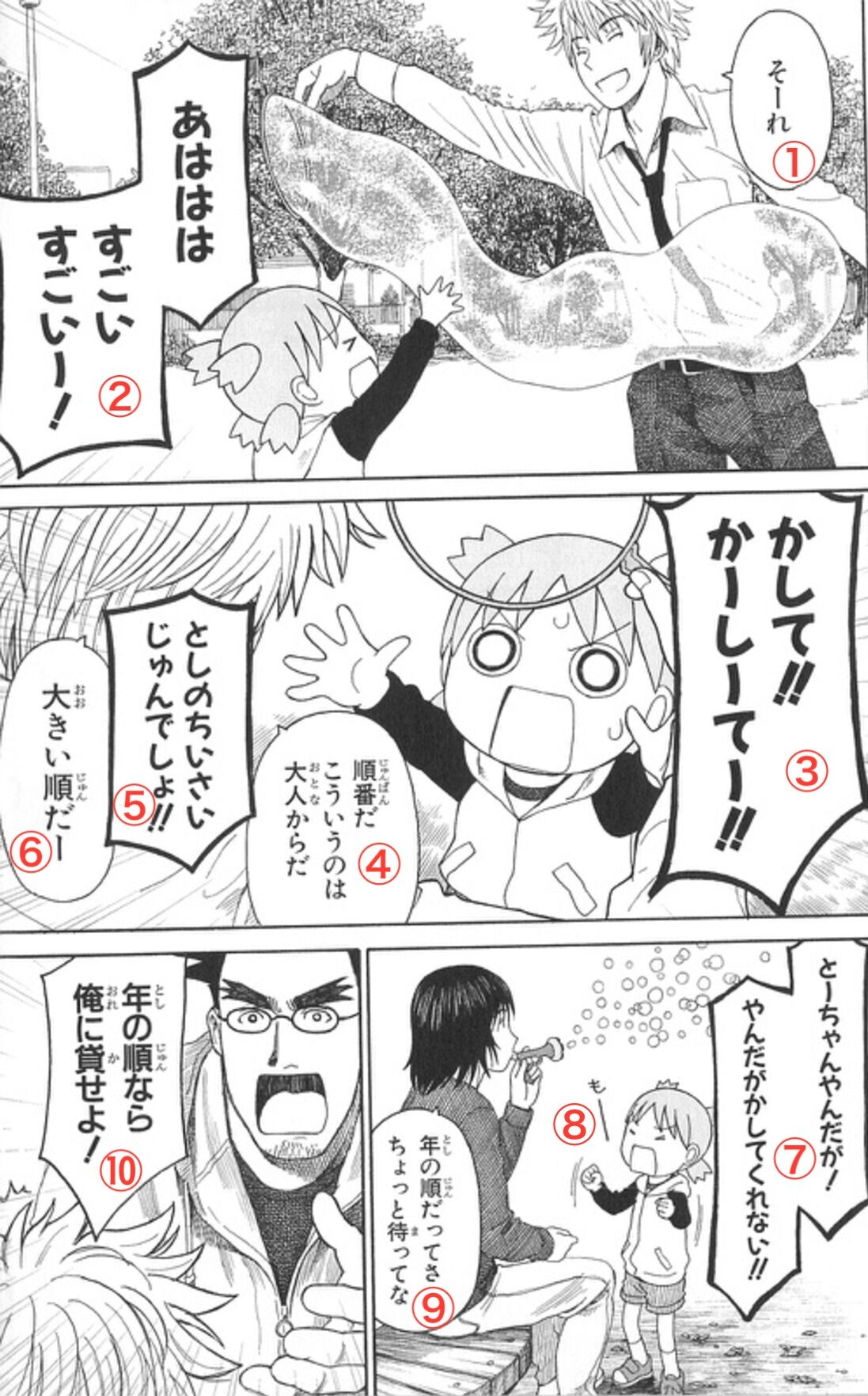 ©よつばと! (電撃コミックス)
Sentences
Hover or tap to reveal the censored romaji and English translation.
そーれ
sōre
There you go!
あははは すごいすごいー!
ahahaha sugoi sugoī!
Hahaha, amazing, amaziiing!かして‼︎ かーしーてー‼︎
kashite!! kāshītē!!
Let me use it!! Let me use it, pleeeease!!
順番だ こういうのは大人からだ
junban da kōiu no wa otona kara da
We’re going in order. For things like this, adults go first.
としのちいさいじゅんでしょ‼︎
toshi no chiisai jun desho!!
It should be in order of youngest first, right?!
大きい順だー
ōkii jun dā
In order of oldest first
とーちゃんやんだが!やんだがかしてくれない‼︎
tōchan yanda ga! yanda ga kashite kurenai!!
Dad, it’s Yanda! Yanda won’t let me use it!!
もー
mō
Geez
年の順だってさ ちょっと待ってな
toshi no jun datte sa chotto matte na
He says it’s in age order. Hold on a sec.
年の順なら俺に貸せよ!
toshi no jun nara ore ni kase yo!
If it’s in age order, then let ME use it!
The dialogue of Yotsuba is mostly written in hiragana to convey her childishness.
Analysis of Manga
「そーれ」
- そーれ (interjection) – there you go (used to muster courage or momentum) EXAMPLES
「あははは すごいすごいー!」
- あははは (interjection) – hahaha (onomatopoeia representing laughter)
- すごい (adjective) – amazing, awesome
- ー (long vowel mark) – used to extend the vowel sound and add emphasis
「かして‼︎ かーしーてー‼︎」
- 貸して (verb te-form for request) – let someone use something temporarily, lend EXAMPLES
- ー (long vowel mark) – used to extend the vowel sound and add emphasis
「順番だ こういうのは大人からだ」
- 順番 (noun) – order, sequence
- だ (auxiliary verb) – used to add a sense of assertion or declaration to the statement (attached to a noun or な-adjective)
- こういう (demonstrative adjective) – like this, this kind of
- の (particle) – nominaliser (makes an adjective into a noun; “one”, “thing”)
- は (particle) – topic marker
- 大人 (noun) – adult
- から (particle) – from
- だ (auxiliary verb) – used to add a sense of assertion or declaration to the statement (attached to a noun or な-adjective)
「としのちいさいじゅんでしょ‼︎」
- 年 (noun) – age
- の (particle) – modifies the following noun
- 小さい (adjective) – small
- 順 (noun) – order, sequence (often used with words indicating a specific arrangement)
- でしょ (auxiliary verb) – used to seek agreement or confirmation
「大きい順だー」
- 大きい (adjective) – big
- 順 (noun) – order, sequence (often compounds with words indicating a specific arrangement)
- だ (auxiliary verb) – used to add a sense of assertion or declaration to the statement (attached to a noun or な-adjective)
- ー (long vowel mark) – used to extend the vowel sound and add emphasis
「とーちゃんやんだが!やんだがかしてくれない‼︎」
- 父ちゃん (noun) – Dad (informal and childish)
- やんだ (proper noun) – Yanda (nickname derived from the surname Yasuda)
- が (particle) – indicates the doer of the action
- 貸して (verb te-form) – let someone use something temporarily, lend
- くれない (auxiliary verb negative form) – won’t do something for the speaker as an act of kindness EXAMPLES
「もー」
- もー (interjection) – geez, ugh (used to express frustration, annoyance, or impatience)
「年の順だってさ ちょっと待ってな」
- 年 (noun) – age
- の (particle) – modifies the following noun
- 順 (noun) – order, sequence (often compounds with words indicating a specific arrangement)
- だって – used to quote (attached to a noun or な-adjective) EXAMPLES
- さ (particle) – used to modulate the speaker’s tone and draw the listener’s attention
- ちょっと (adverb) – a little, just a moment
- 待って (verb te-form for request) – wait
- な (shortened form of なさい) – used to give soft commands or requests (less formal and softer than なさい)
「年の順なら俺に貸せよ!」
- 年 (noun) – age
- の (particle) – modifies the following noun
- 順 (noun) – order, sequence (often compounds with words indicating a specific arrangement)
- なら (conjunction) – if, given, supposing EXAMPLES
- 俺 (noun) – I (used by males)
- に (particle) – indicates the direction of an action
- 貸せ (verb imperative form) – let someone use something temporarily, lend
- よ (particle) – used to make the listener aware of the information
Examples
それ (interjection used to muster courage or momentum)
(ボールを投げながら)そーれ!
(bōru o nagenagara) sōre!
(Throwing a ball) Here it comes!
「それっ」と勢いをつけて雑草を引き抜いた。
“sore!” to ikioi o tsukete zassō o hikinuita.
I yanked out the weed adding momentum with a ‘Heave-ho!’
それ、行くよ!
sore, iku yo!
Alright, let’s go!
When それ is directly followed by a verb, it functions as an emphatic interjection, adding force and immediacy to the verb that follows. It’s used to encourage action, express triumph, or draw attention to something happening or about to happen.
それいけ!アンパンマン
soreike! anpanman
Go for it! Anpanman
It’s the title of a popular kids’ anime series.
それ見たことか!
sore mita koto ka!
There, you see! / I told you so!
Expression used when a prediction or warning comes true.
貸す (let someone use something temporarily)
ちょっと手を貸してくれる?
chotto te o kashite kureru?
Can you give me a hand for a moment?
友達に貸したお金が返ってこない 。
tomodachi ni kashita okane ga kaette konai.
The money I lent to my friend hasn’t been returned.
喫煙所で知らない人にタバコの火を貸した。
kitsuenjo de shiranai hito ni tabako no hi o kashita.
I lent a light to a stranger in the smoking area.
Verb Te-Form + くれる (to do something for the speaker)
友達が宿題を手伝ってくれた。
tomodachi ga shukudai o tetsudatte kureta.
My friend helped me with my homework.
毎朝、母が朝ごはんを作ってくれる。
maiasa, haha ga asagohan o tsukutte kureru.
Every morning, my mother makes breakfast for me.
先生が丁寧に説明してくれた。
sensei ga teinei ni setsumei shite kureta.
The teacher explained it to me carefully.
It can also be used for someone close to the speaker.
うちの子にボールを貸してくれてありがとう。
uchi no ko ni bōru o kashite kurete arigatō.
Thanks for letting my kid borrow your ball.
Noun / な-Adjective + だって (used to quote)
明日、雨だって。試合は中止だね。
ashita ame datte. shiai wa chūshi da ne.
They say it’s going to rain tomorrow. The game will be cancelled.
先週は風邪でダウンしてたけど、今は元気だってよ。
senshū wa kaze de daun shiteta kedo, ima wa genki datte yo.
He/She was down with a cold last week, but I hear he/she is feeling better now.
あの白い犬、ビションじゃなくてトイプードルだって。
ano shiroi inu, bishon janakute toi pūdoru datte.
I heard that the white dog is a toy poodle, not a Bichon.
For verbs and い-adjectives, we usually use って directly after the word.
山田さん遅れるって。
yamada-san okureru tte.
Mr. Yamada said he will be late.
だって/って is only used in colloquial speech. In formal speech, [nouns/な-adjectives] だそうです/[verbs/い-adjectives] そうです is used.
明日は雨だそうです。
ashita wa ame da sō desu.
I hear it will rain tomorrow.
山田さんは遅れるそうです。
yamada-san okureru sō desu.
Mr. Yamada said he will be late.
You can also use だって immediately after quoting the other person’s words to indicate that you find the quoted words surprising, unbelievable, or worthy of criticism. In this usage, it cannot be replaced with だそうです.
ごめんねだって?それで済むと思ってるの?
gomen ne datte? sore de sumu to omotteru no?
You’re saying sorry? Do you think that’s enough?
なら (if, given, supposing)
明日雨なら、うちで映画を見よう。
ashita ame nara, uchi de eiga o miyō.
If it rains tomorrow, let’s watch a movie at home.
そんなに仕事が辛いなら、辞めたら?
sonna ni shigoto ga tsurai nara, yametara?
If the job is that tough for you, why don’t you quit?
海外に行くなら、シンガポールがおすすめだよ。
kaigai ni iku nara, shingapōru ga osusume da yo.
If you’re going abroad, I recommend Singapore.
なら is often used to refer to information already mentioned in the conversation or to introduce new information as a condition, and the consequent often includes the speaker’s judgment or opinion.
In this scene, the guy refers to age order (information already mentioned in the conversation) as a condition, and expresses his own judgment (in this case, a request) based on that condition.
Support Easy Peasy Japanesey
If you enjoy our content, please consider supporting Easy Peasy Japanesey. Your support will help keep us going. Thank you for your support!