Let’s learn Japanese with our analysis of manga. We will analyse a manga snippet from Yotsubato! (よつばと!) Volume 12.
CONTENTS
Manga Snippet
 ©よつばと! (電撃コミックス)
Sentences
Hover or tap to reveal the censored romaji and English translation.
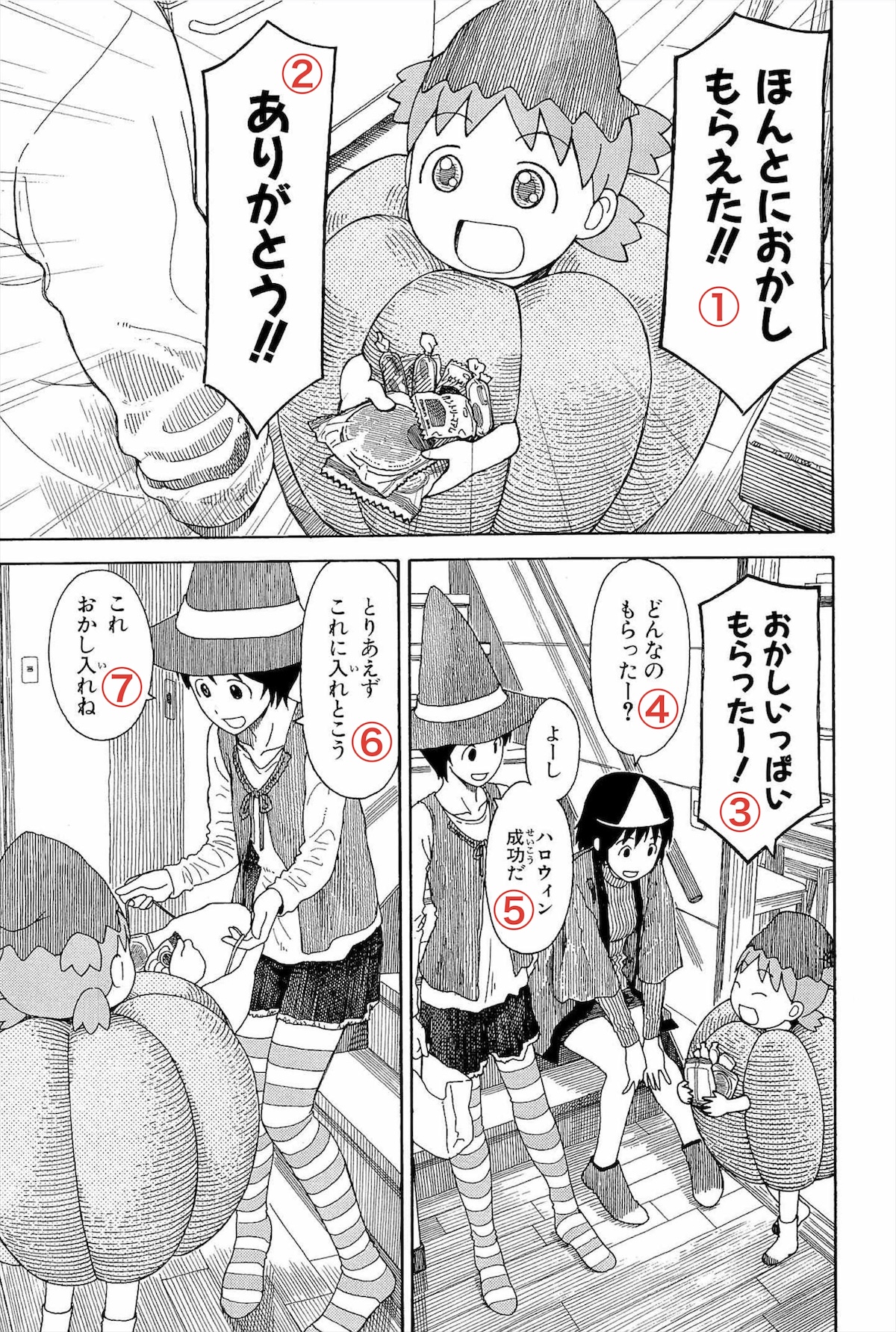
ほんとにおかしもらえた‼︎
honto ni okashi moraeta‼
I really got snacks‼
ありがとう‼︎
arigatō‼
Thank you‼
おかしいっぱいもらったー!
okashi ippai morattā!
I got lots of snacks!
どんなのもらったー?
donna no morattā?
What kind did you get?
よーし ハロウィン成功だ
yōshi harowin seikō da
Alright, Halloween was a success.
とりあえずこれに入れとこう
toriaezu kore ni iretokō
For now, let’s put them in this.
これおかし入れね
kore okashi ire ne
This is a snack container, okay?
The dialogue of Yotsuba is mostly written in hiragana to convey her childishness.
Analysis of Manga
「ほんとにおかしもらえた‼︎」
- ほんとに (adverb) – really, truly
- おかし (noun) – snacks, sweets
- もらえた (verb potential form past tense) – was able to receive
「ありがとう‼︎」
ありがとう (interjection) – thank you
「おかしいっぱいもらったー!」
- おかし (noun) – snacks, sweets
- いっぱい (adverb) – a lot, plenty
- もらった (verb past tense) – received
- ー (long vowel mark) – used to extend the vowel sound and add emphasis
「どんなのもらったー?」
- どんな (interrogative adjective) – what kind of
- の (particle) – nominaliser (makes an adjective into a noun; “one”, “thing”)
- もらった (verb past tense) – received
- ー (long vowel mark) – used to extend the vowel sound and add emphasis
「よーし ハロウィン成功だ」
- よーし (interjection) – alright, okay (expresses determination, encouragement, or approval) EXAMPLES
- ハロウィン (noun) – Halloween
- 成功 (noun) – success
- だ (auxiliary verb) – used to add a sense of assertion or declaration to the statement (attached to a noun or な-adjective)
「とりあえずこれに入れとこう」
「これおかし入れね」
- これ (pronoun) – this
- おかし (noun) – snacks, sweets
- 入れ (noun) – container, something to put things in
- ね (particle) – ok?, yeah? (used to seek acknowledgment or confirmation) EXAMPLES
Examples
よし (expresses determination, encouragement, or approval)
よし、やるぞ!
yoshi, yaru zo!
Alright, I’m gonna do this!
よーし、いいぞ。その調子だ!
yōshi, ii zo. sono chōshi da!
Alright, good! Keep it up!
(一問解いて)よし、できた。次!
(ichi mon toite) yoshi, dekita. tsugi!
(After solving one question) Okay, done. Next!
よし comes from the adjective 良い (good), and is commonly used when psyching oneself up, encouraging others to take action, or showing approval of someone’s performance. The elongated version (よーし) sounds more energetic and enthusiastic.
とりあえず (for now, for the time being)
(注文する時)とりあえずビールで!
(chūmon suru toki) toriaezu bīru de!
(When ordering) Beer for now! / I’ll start with beer!
今日は疲れたから、とりあえず寝よう。
kyō wa tsukareta kara, toriaezu neyō.
I’m tired today, so I’ll just go to bed for now.
とりあえず、ここに荷物を置いておこう。
toriaezu, koko ni nimotsu o oite okō.
For now, let’s put/leave the luggage here.
〜ておく/〜とく (to do something in advance or leave something in a certain state)
明日のためにお弁当を作っておく。
ashita no tame ni obentō o tsukutte oku.
I’ll make a lunch box in advance for tomorrow.
ドアを開けておいてください。
doa o akete oite kudasai.
Please leave the door open.
明日は遊びに行くから、今のうちに宿題しとこう。
ashita wa asobi ni iku kara, ima no uchi ni shukudai shitokō.
I’m going out to play tomorrow, so I’ll do my homework now (while I have time).
“Verb Te-form + おく” indicates doing something in preparation for the future or maintaining a certain state. 〜ておく is often contracted to 〜とく in casual speech. 入れとこう in the manga is a contracted form of 入れておこう (the volitional form of 入れておく), meaning “let’s put (the snacks) in (the container) and keep them there”.
Noun + ね (particle used to seek acknowledgment or confirmation)
また明日ね。
mata ashita ne.
See you tomorrow, okay?
はい、これ、新しい鍵ね。
hai, kore, atarashii kagi ne.
Here, this is the new key, okay?
集合場所は駅前ね。
shūgō basho wa ekimae ne.
The meeting place is in front of the station, okay?
When ね follows a noun directly (without だ), it’s used to present information while seeking acknowledgment or confirmation from the listener in casual speech. It’s often used when explaining, reminding, or pointing something out. In the manga example 「これおかし入れね」, the speaker is identifying/presenting “this” as a snack container while seeking the listener’s acknowledgment.
Support Easy Peasy Japanesey
If you enjoy our content, please consider supporting Easy Peasy Japanesey. Your support will help keep us going. Thank you for your support!